
The default option in Newsletter Studio is to send emails using the SMTP protocol. Most email service providers like SendInBlue, Mailgun, Mailjet, and Amazon SES support this protocol.
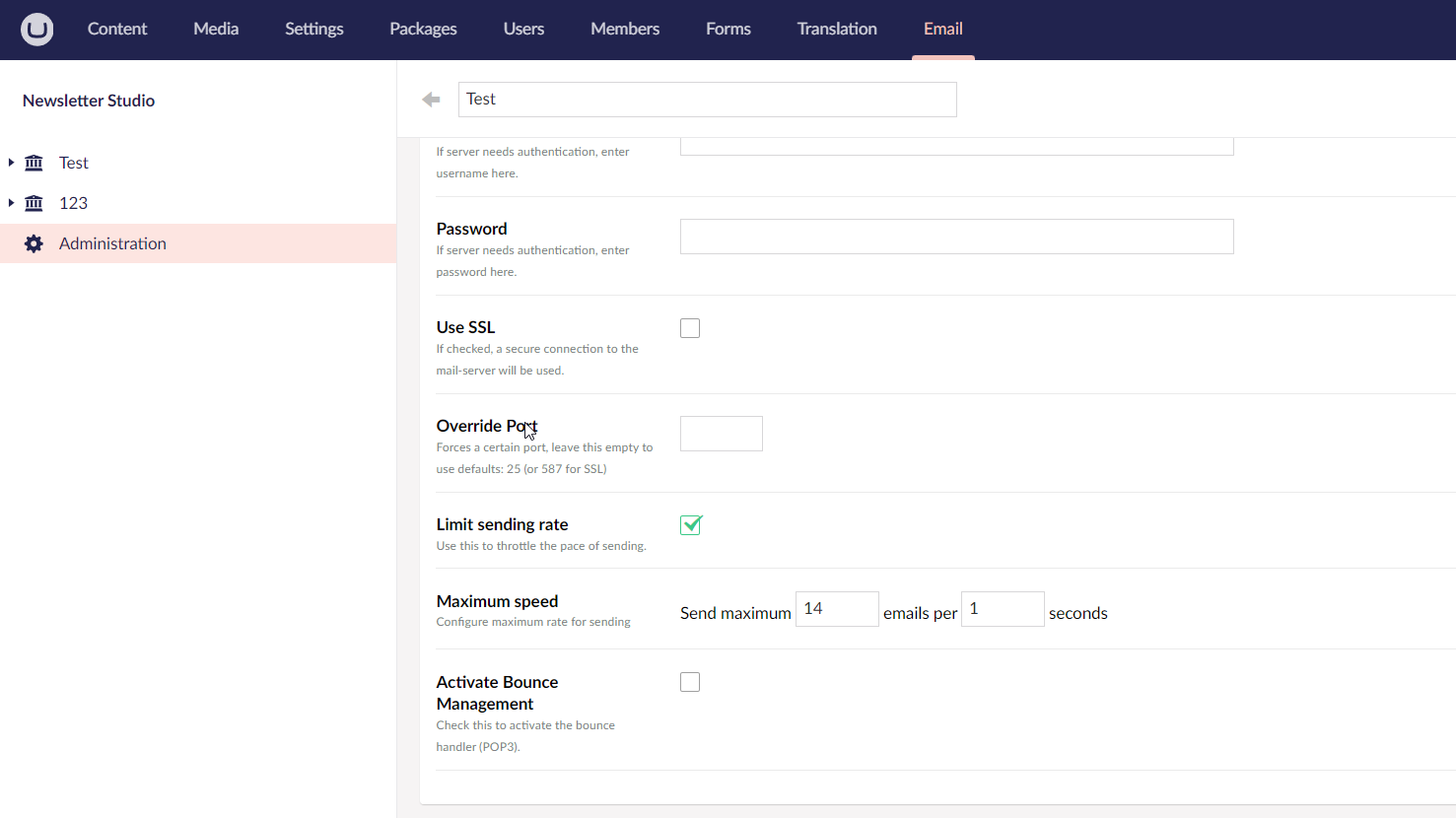
Be aware that some SMTP relay services apply rate limits for how fast you are allowed to send via their service. If your provider enforces restrictions, you can use our rate limit feature when you configure SMTP to respect your provider's limits.
When a campaign is sent, a coordinator will create a queue and spin up a number of workers to process the queue. The workers will process the queue by claiming a batch of emails for delivery, perform the delivery using an Email Service Provider and report back to the coordinator.

The package ships with configuration defaults that keep a balance between speed, server/database load, checkpointing and the most common rate limit restrictions with SMTP Providers.
The default batch size is intentionally small to allow frequent checkpointing. This ensures that progress is persisted regularly and limits how much work needs to be retried if an unhandled exception occurs.
If you need to send faster, you can adjust these settings to raise the throughput. The trade-offs include load and checkpointing, depending on your settings.
There are two "layers" of configuration:
These settings are configured by the Email Service Provider depending on the supported batch sizes. Email Service Providers allow configuration of:
For example, a provider that sends using a REST API might support sending 25 emails in a single call to the API-service. It might claim 100 items from the queue (Max Items Per Batch) and then send them in 4 calls to the service (Send Batch Size).
Another scenario is SMTP, we might want to claim 10 items from the queue (Max Items Per Batch) and ensure that we persist the state after each delivery by setting Send Batch Size to 1.
Configuration could be internal to the concrete Email Service Provider implementation, but some of them expose settings that you can configure. You could also implement your own from scratch or by inheriting from an existing provider.
The worker manager configuration applies at a higher level and allows you to override batch settings from Email Service Providers.
The configuration includes:
MaxItemsPerBatch on the Email Service Provider is used. This setting can be used to limit the load if the Email Service Provider has a very high batch size and your infrastructure is under heavy load during sending. (default: 10)You can use appsettings.json to override the default values
{
    "NewsletterStudio" : {
        "Delivery": {
            "Workers": 10,
            "CycleBatchSize": 20,
            "SendBatchSize": 10
        }
    }
}
Delivery.Workers, the number of workers to use while progressing the queue.Delivery.CycleBatchSize, the number of items to claim from the queue in each cycle. Sets the max batch size for both workers and SMTP-implementation.Delivery.SendBatchSize, applies to default SMTP-implementation. The number of emails to send before persisting the result to the database.You are encouraged to test settings and measure the results in your specific environment, a couple of things to keep in mind:
If you want to handle bounces for your emails you can provide a mailbox where the package can look for these bounce emails. The package will check periodically and update the state of the recipients and any tracking information if it detects a bounce.
The logic for detecting a bounce is based on the industry standards and looks for the status-header in the email. This header should contain a number indicating any issues. We also look at the headers diagnostic-code and final-recipient to figure out if the email is in fact a bounce and who was the intended recipient. The "bounce-email" is sent from the intended recipient's mail server and not all mail servers follow standards. This means that the package might be unable to parse certain bounce emails, this is natural as we don't want to set a recipient as bounced if we're not 100% sure.
You can override our logic for determining bounces using the BounceDetector.OnDetectingBounce-event handler like this:
using NewsletterStudio.Core.Mail.Common;
using Umbraco.Cms.Core.Composing;

public class HandleBouncesComposer : IComposer
{
    public void Compose(IUmbracoBuilder builder)
    {
        BounceDetector.OnDetectingBounce += (object sender, OnDetectingBounceEventArgs args) =>
        {
            // Inspect message
            if (args.Message.RawContent.Contains("invalid recipient"))
            {
                var recipientEmail = "recipient@example.com";

                // Set OverrideResult to override the result
                // from the built-in bounce parser.
                args.OverrideResult = new BounceResult()
                {
                    IsHardBounce = true,
                    FinalRecipient = recipientEmail
                };
            }

        };
    }
}